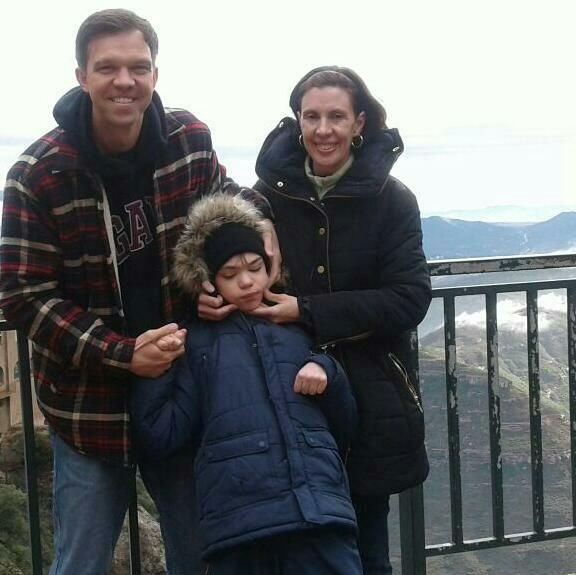
To this day, I remember the first moment I saw my son Arthur right after his birth, which, I can
guarantee, was the happiest day of my life.
In the first few months, everything seemed to be going normally, but we noticed that Arthur
didn’t look us in the face like other babies and that some developmental milestones weren’t
being reached, which was also noticed by the pediatrician who advised us to seek follow-up
with a neuropediatrician. Hearing the word neuropediatrician triggered an alarm inside me,
and I realized that something was very wrong with my son.
I managed to schedule an appointment with a neuropediatrician specialist in rare diseases,
recommended by the pediatrician, and when she examined him, she explained to me that tests
would be necessary to reach a diagnosis, but that it was extremely important to start
immediately various early therapies and referred him to an ophthalmologist who confirmed
the diagnosis of cortical visual impairment.
During a consultation, just after his first birthday, while we were still waiting for the results of
some tests in the hope of a diagnosis, the doctor explained me that, regardless of the
diagnosis, Arthur would be a child with many motor difficulties and would need therapies for
many years. At that moment, I burst into tears, because for the first time I was aware of what
lay ahead.
At 16 months, the seizures began, and we started the routine of trying to control the seizures
until we found a combination of medications that contained the epilepsy.
After years of hard work with physiotherapy, equine therapy, hydrotherapy, speech therapy,
occupational therapy, and visual stimulation, my boy began to progress, and this encouraged
us greatly, even though he hadn’t started speaking and still couldn’t walk without support. But
at age 8, inexplicably, Arthur went into status epilepticus, was taken to the ICU, and the
doctors thought he wouldn’t survive, but miraculously he resisted, and after a few months he
was back in full swing and, to our joy, walking without support.
Shortly after his 11th birthday, we received the results of the exome sequencing test with the
diagnosis of GRIN2B, and in researching to understand the diagnosis, I found that the
characteristics perfectly fit our son, which is why we were not surprised and found that the
doctors and therapists, even without knowing the diagnosis, had adopted the correct
procedures.
Epilepsy has always been our greatest enemy because it gradually robbed from our boy all the
gains obtained with the therapies, but even so we didn’t give up and continued to stimulate
him, in addition to seeking other treatment alternatives such as CBD and the keto diet, but
unfortunately in adolescence the seizures got worse and Arthur lost all motor skills, including
swallowing. He no longer smiled and in the last months we realized that he was tired of the
battle that lasted almost 19 years.
Seeing him in that state, we wondered how long he would last, but even knowing that at some
point he wouldn’t survive, we weren’t prepared for his passing, which happened very quickly
and traumatically.
We know that when he left, our son was free from all the suffering imposed on him by
epilepsy, motor limitations, and the inability to express himself, and that today, for sure, he is
living in heaven, which is the place reserved for angels like him.
But the pain we feel with his absence always accompanies us, even in moments of joy, as if to
prevent us from forgetting him, which is impossible because the love we always felt for our
son is infinite.
With Arthur, I learned that in life it is necessary to always fight. To fight against the health
insurance that seeks by all means to deny exams and treatments, to fight against the
educational system that is not interested in the inclusion of children who don’t fit the
standards of exemplary students, to fight against a society that prefers to ignore those who are
different.
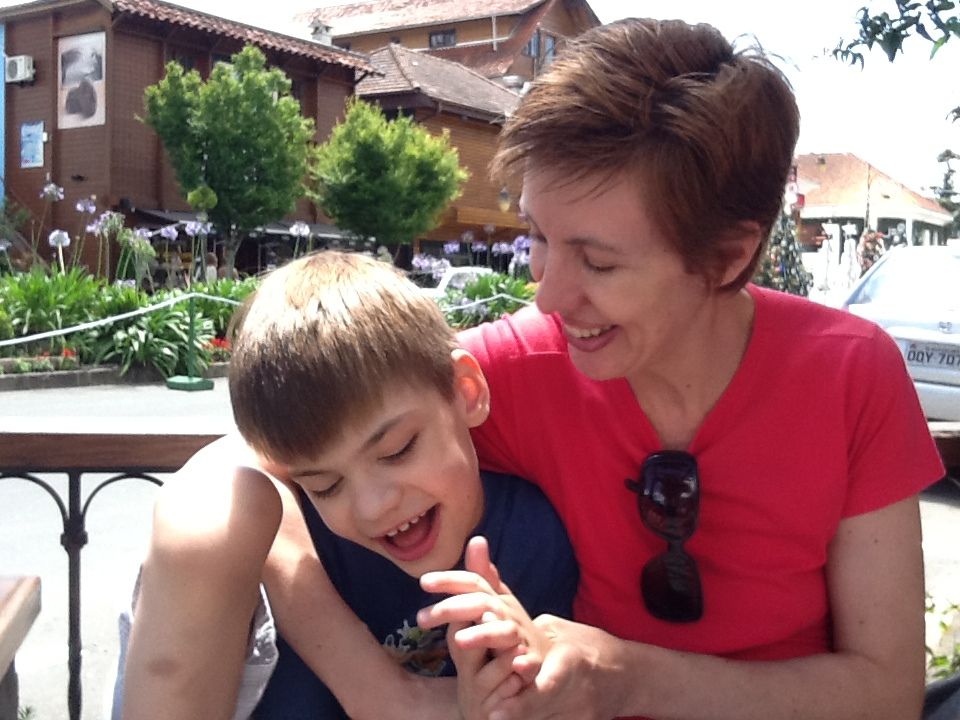
Despite all the difficulties, for us, hiding our son from the world was never an option. On the
contrary, we went out with him to parks, to movies, meetings and parties with friends, and
many trips, and I can say that in our own way we were happy, because a life different from the
idealized one is not a sad life.